
Let me ask you something, and I want you to answer honestly.
When was the last time you felt completely clear about where you were going as a leader? Not just busy. Not just getting through the week. But genuinely, intentionally clear about the direction you were heading, how you were communicating with your team, and whether those around you felt truly connected to you and the vision?
If you had to pause and think about it… that pause is telling you something.
You’re not alone. And more importantly, this is not a failure. It’s something I call Leadership Drift, and it’s one of the most common and misunderstood challenges leaders face today.
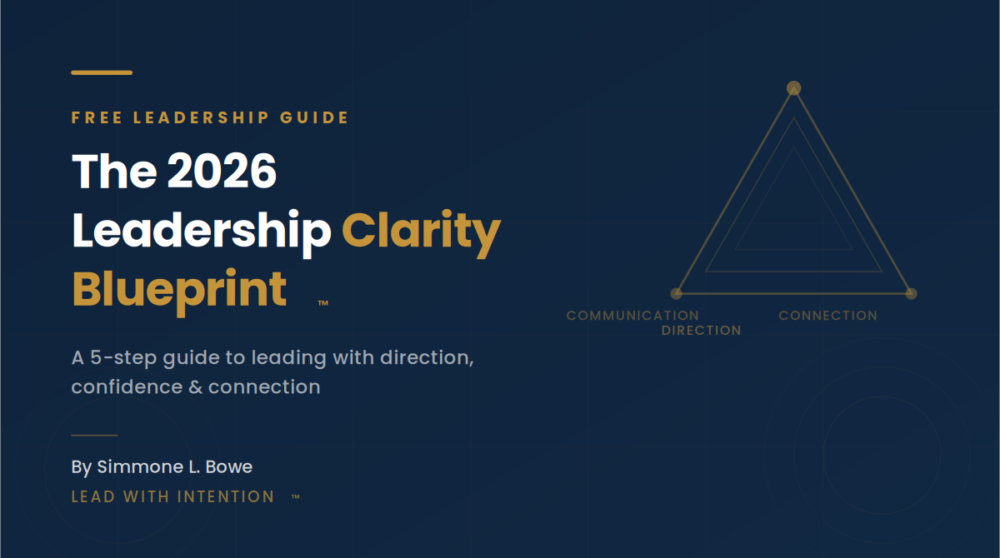
That’s exactly why I created The 2026 Leadership Clarity Blueprint™ — a practical, no-fluff guide designed to help you cut through the noise, reclaim your focus, and lead with the kind of clarity that transforms everything.
Let me walk you through it.
The Leadership Drift Problem: Why Good Leaders Lose Their Way
Here’s the truth that nobody talks about at leadership conferences:
Most leaders don’t fail from lack of skill. They drift from lack of clarity.
You were promoted because you’re talented. You’ve earned your seat at the table. You know your stuff. But somewhere along the way — between the back-to-back meetings, the constant fires to put out, and the pressure to perform — something shifted. You stopped leading with intention and started surviving on autopilot.
That’s drift. And it’s silent. It doesn’t send you a calendar invite or announce itself in your inbox. It creeps in slowly, and before you know it, you’re leading a team that feels just as lost as you do.
Drift looks like:
Unclear expectations. Your team is working hard — you can see the effort — but they’re not always moving in the right direction. Deadlines get missed. Deliverables come back off-target. And you find yourself wondering, “Did I not explain this clearly enough?” (Spoiler: probably not, and that’s okay. That’s fixable.)
Reactive communication. Instead of proactively directing your team, you’re constantly responding. Putting out fires. Answering questions that shouldn’t need answering. You’re communicating all day long — but none of it feels strategic. It all feels like damage control.
Disconnected teams. Your people are physically present (or logged on), but something is off. There’s no spark. No real engagement. They do the work, but the energy behind it is flat. The trust, the alignment, the sense of “we’re in this together” — it’s fading.
Quiet burnout. This is the one that sneaks up on the best of us. You’re exhausted, but you can’t quite pinpoint why. Your calendar is full, but your sense of purpose feels empty. You’re giving everything to everyone else and quietly running on fumes yourself.
Sound familiar? Then keep reading — because this is exactly where the Blueprint begins.
The Leadership Clarity Triangle: The Framework That Changes Everything
Through years of working with leaders across the Caribbean and the United States — from corporate boardrooms to growing small businesses — I’ve found that leadership clarity comes down to three essential pillars. I call it The Leadership Clarity Triangle:
1. Clear Direction
Your team needs to know where they’re going. Not just the annual targets or the company mission statement printed on the wall — but the real, felt sense of direction that comes from a leader who knows exactly what they’re building and why. When direction is clear, decisions become easier, priorities become obvious, and momentum becomes natural.
2. Clear Communication
Direction without communication is just a thought in your head. Your team can’t read your mind. Clear communication means saying what you mean, setting expectations that leave no room for guesswork, giving feedback that actually helps people grow, and creating space for honest conversation. It’s not about talking more — it’s about talking with purpose.
3. Meaningful Connection
This is the one leaders most often underestimate. You can have the clearest strategy and the sharpest communication, but if your team doesn’t feel connected — to you, to each other, to the mission — everything falls apart. Connection is the glue. It’s what turns a group of employees into a team that actually cares.
Here’s the key insight: when even one of these three pillars is missing, leadership feels heavy. That weight you’ve been carrying? It’s not because you’re not good enough. It’s because one (or more) of these pillars needs attention.
The Blueprint helps you identify which one and gives you a clear path forward.
The 5-Step Blueprint: Your Roadmap to Leadership Clarity in 2026
This isn’t theory. These are five practical, actionable steps you can start implementing today. Each one is designed to take you from drift back to direction — step by step.
STEP 1: Clarify Your 2026 Leadership Vision
Everything starts here. Before you can lead others with clarity, you need to get clear on your own leadership identity and direction.
I want you to sit with this prompt — really sit with it:
“By December 2026, I want my team to describe my leadership as…”
Don’t rush this. Don’t write what sounds good on LinkedIn. Write what’s true. What kind of leader do you actually want to be? How do you want people to feel after working with you for the next year?
This isn’t about perfection. It’s about intention. And once you have this anchor, every decision, conversation, and interaction becomes easier — because you have a north star.
STEP 2: Identify One Expectation That Needs Clarity
Here’s a powerful exercise: think about one area where your team consistently misses the mark, underperforms, or seems confused. Now, instead of blaming them, ask yourself — have I been truly clear about what I expect?
Nine times out of ten, the gap isn’t in your team’s ability. It’s in the clarity of the expectation itself.
The Blueprint gives you a simple framework to rewrite that expectation using four components:
- Context — Why does this matter? What’s the bigger picture?
- Outcome — What does “done well” actually look like?
- Support — What resources, tools, or guidance will you provide?
- Follow-up — When and how will you check in?
When you communicate expectations using this structure, you eliminate ambiguity. And when ambiguity disappears, performance rises.
STEP 3: Strengthen One Feedback Habit
Let me ask you a question that might sting a little:
“Where am I softening my clarity to avoid discomfort?”
We all do it. We water down feedback to keep the peace. We say “it was fine” when it wasn’t. We avoid the hard conversation because we don’t want to be “that” boss. But here’s the thing — avoiding honest feedback doesn’t protect your team. It holds them back.
Step 3 challenges you to pick one feedback habit and strengthen it. Maybe it’s being more direct in performance conversations. Maybe it’s addressing issues in real time instead of letting them fester. Maybe it’s learning to give feedback that’s both kind and clear — because those two things are not opposites.
The leaders who grow the fastest are the ones who learn that clarity is kindness.
STEP 4: Design One Team Connection Ritual
Connection doesn’t happen by accident. In today’s world of hybrid teams, packed schedules, and constant digital noise, you have to be intentional about building it.
Step 4 asks you to design one simple, repeatable ritual that strengthens the bond between you and your team. It doesn’t have to be complicated. Some of the most powerful examples I’ve seen include:
- A weekly 10-minute check-in — Not about tasks. About people. “How are you really doing?” goes a long way.
- A monthly development conversation — One-on-one time focused on growth, not just performance metrics.
- A public recognition habit — Regularly calling out wins, effort, and growth where everyone can see it.
Pick one. Commit to it. Watch what changes when your team feels seen, heard, and valued — consistently.
STEP 5: Protect Your Personal Leadership Energy
You cannot lead well if you are running on empty. Period.
This final step is about you — not your team, not your organisation, not your to-do list. You.
The Blueprint asks you to identify two things:
One boundary. What is one thing you need to stop tolerating, stop saying yes to, or stop allowing to drain you? Maybe it’s after-hours emails. Maybe it’s meetings that should have been messages. Maybe it’s taking on work that belongs to someone else. Name it. Draw the line.
One renewal practice. What is one thing that genuinely refills your cup? Not what looks good on Instagram — what actually works for you. A morning walk. Journaling. Time with family. An hour of silence. Whatever it is, protect it like your leadership depends on it — because it does.
The strongest leaders I know aren’t the ones who grind 24/7. They’re the ones who guard their energy fiercely so they can show up as their best when it matters most.
This Is Your Starting Point
If you’ve read this far, you already have more clarity than you did 10 minutes ago. That’s not a coincidence — that’s the Blueprint at work.
But reading about it and doing it are two different things. That’s why I want you to download the full 2026 Leadership Clarity Blueprint™ — it’s free, it’s practical, and it’s designed for leaders like you who are ready to stop drifting and start leading with real intention.
Inside the Blueprint, you’ll find the complete framework, guided prompts, and space to work through each of the five steps at your own pace. No fluff. No overwhelm. Just clarity.
Ready to Go Even Deeper?
The Blueprint is your foundation. But if you’re ready for a complete leadership transformation — the kind that changes how you lead, how your team performs, and how you feel at the end of every day — then I’d love for you to explore the POWERedUP Leadership Framework.
It’s my signature program where we go beyond the basics and build a leadership practice that is sustainable, strategic, and deeply connected to who you are.
Join the waiting list for the POWERedUP Leadership Framework!